NEW BOOK
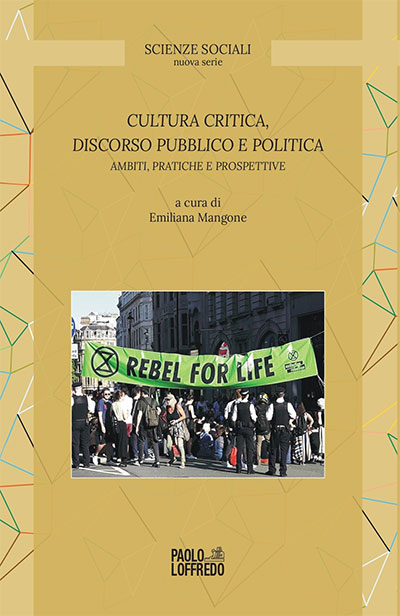
Mangone E. (Ed.) (2026). Cultura critica, discorso pubblico e politica. Ambiti, pratiche e prospettive. Paolo Loffredo, Napoli. (ISBN: 979-12-82421-08-9).
Back cover
The aim of this book is to contribute to the scholarly debate on emerging cultural and communicative phenomena in a fragmented society, which are assuming significant proportions in the contemporary landscape through their interconnections with processes of platformization, information, and democratization. To achieve this goal, it is essential to trace the origins and development of these phenomena, including through a reinterpretation and reconfiguration of the relationship between culture, power, and politics within the social space where not only role-based functions are fulfilled, but also denunciation and criticism. This book, therefore, brings together contributions that explore several areas specifically addressing the reconfiguration of this relationship. The first, “Culture, Participation and Politics” (with contributions by Salyanna de Souza Silva, Lucia Boccacin, Michele Sorice and Andrea Volterrani, and Lorenzo Viviani), prompts us to reflect, even from a non-European perspective, on understanding the role of culture in the pursuit of pluralism, the changes and transformations of participatory processes, from a new perspective: the constant opening and broadening of the foundations of democracy that has led to the culturalization of politics. The second, “Journalism, Public Discourse and Narration” (with contributions by Carlo Sorrentino, Fabiana Battisti, Roberto Mincigrucci and Marco Mazzoni, Grazia Enerina Pisano, and Francesca Cubeddu), begins with the transformations of journalism and presents a careful examination of the implications of all information and narrative processes for ensuring non-polarized public discourse, the integrity of information, and the protection of fundamental rights. and, finally, the third, “Public discourse, gender and discrimination” (contributions by Giuseppe Masullo and Lucia Picarella, Daniele Battista, and Marianna Coppola), which examines the relationship between public discourse, gender and discrimination, underlining the need for greater awareness of this relationship and fewer polarized discourses that claim gender equality without respecting it.
 Emiliana Mangone